
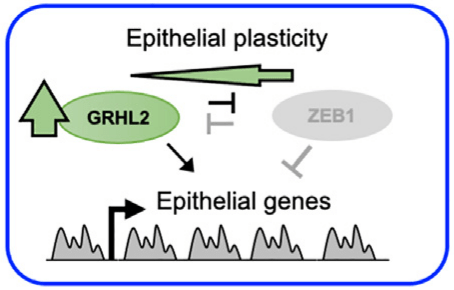
This study sheds light on the mechanisms underlying the progression of metastatic breast cancer. Resistance to epithelial-mesenchymal transition (EMT) plays a crucial role in sustaining the clonal propagation of metastatic breast cancer. EPCAM(high) cells from metastatic biopsies have the ability to propagate breast cancer in xenografts. Irreversible EMT leads to restrained tumorigenic potential in specific clonal subsets. ZEB1 and its target GRHL2 are key regulators of distinct epigenetic pathways associated with EMT susceptibility. These findings provide potential targets for therapeutic interventions and contribute to our understanding of the mechanisms underlying metastatic breast cancer.
Nice collaboration with Christina Scheel in the context of SFB1321.
published in Cell reports
 The Schotta Lab